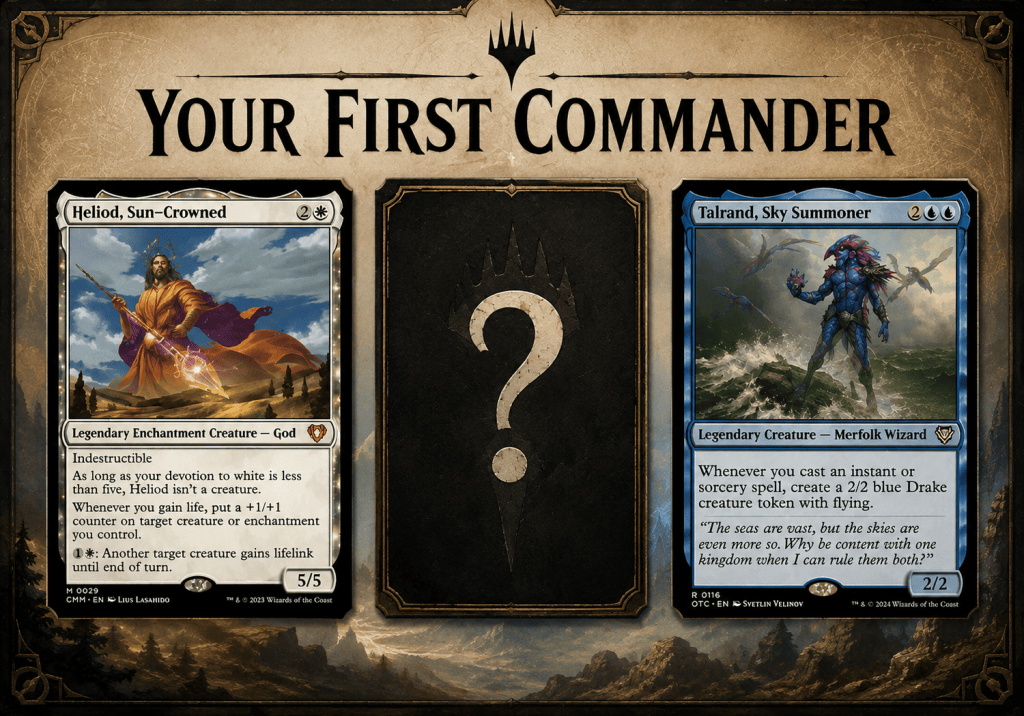
Choosing a commander is one of the most important decisions you’ll make in Magic: The Gathering’s Commander format. The commander you pick shapes your deck’s identity, your strategy, the pace of your games, and even how you interact with the table.
Instead of picking whatever’s popular, the best approach is simple: pick a commander that matches your personal playstyle.
1. Know Your Playstyle
Even if you’re new to Commander, you already lean toward certain strategies. Below are five solid playstyle categories and what each actually does in-game.
Aggro — “I want to end the game quickly.”
Aggro decks want early board presence and consistent combat damage.
Examples include Najeela, the Blade-Blossom, which offers fast combat and combo options, and token-makers like Krenko, Mob Boss. Najeela’s common competitive builds aim to end the game quickly using extra combat steps and low-cost interaction, while Krenko is a Goblin token generator that scales with the number of Goblins you control.
Control — “I like saying ‘no.’”
Control decks slow the game, remove threats, and win later.
Commanders typically provide card selection, tempo swings, or repeatable interaction. Aminatou, the Fateshifter, for example, is a planeswalker frequently used for tempo and card manipulation.
Midrange — “I’ll win when the time is right.”
Midrange decks use efficient threats and answers. They pivot between aggression and defense depending on the board state.
Examples include flexible commanders that provide incremental value and adapt to different games.
Combo — “Let me cook.”
Combo players assemble interactions that win in a single sequence.
Commanders that enable tutoring, token and sacrifice loops, or artifact engines are common examples. This includes commanders that produce Treasure, tutor for important pieces, or provide powerful mana engines.
Battlecruiser — “Bigger is better.”
These decks use big creatures and splashy spells as their primary plan.
Ramping into huge finishers is the theme, whether that means casting a massive commander or dropping a game-changing spell.
2. What Your Commander Should Do
Pick the commander role that matches how you like to play:
- Value engine: Repeats resources such as card draw, tokens, or recursion.
- Big finisher: Your commander is the win condition.
- Strategy enabler: Your commander enables a tribe, artifact strategy, or mechanic.
- Flexible utility: Supports multiple play patterns without forcing you into one.
For example, Jor Kadeen, First Goldwarden scales with Equipment, making him a great choice for an Equipment (Voltron) strategy.
Talrand, Sky Summoner is a classic spellslinger commander that creates Drake tokens whenever you cast an instant or sorcery.
3. Key Questions to Ask Before Locking In
Answer these questions to help narrow down your choices:
- Do you want to be proactive or reactive? Think aggro/combo versus control/stax.
- Do you prefer synergy or raw power? Think tribal/engine decks versus goodstuff.
- Do you enjoy complex sequencing or straightforward turns?
- Do you want to be the obvious threat at the table or would you rather fly under the radar?
Your answers will eliminate many commanders pretty quickly.
4. Example Playstyles and Commanders
Here are a few examples of different playstyles and commanders that fit them:
- Drawing / Interaction / Tempo: Aminatou, the Fateshifter — a planeswalker used to sculpt hands and generate value.
- Token / Swarm: Krenko, Mob Boss — creates large numbers of Goblin tokens and is an archetypal token commander.
- Spellslinger / Instant-Sorcery Value: Talrand, Sky Summoner — makes 2/2 flying Drake tokens whenever you cast instants or sorceries.
- Aristocrats / Sacrifice Value: Korvold, Fae-Cursed King — rewards you for sacrificing permanents by drawing cards and growing stronger.
- Artifact / Engine Toolbox: Urza, Lord High Artificer — a centerpiece for artifact-engine strategies and numerous mana combos.
5. Test, Adjust, and Iterate
Commander is about experimentation.
Try this cycle:
- Pick a commander that matches your playstyle.
- Build the 99 to emphasize your commander’s strengths. Focus on synergy rather than simply adding random powerful cards.
- Play several games and pay attention to what felt fun and what felt frustrating.
- Adjust your commander or the other 99 cards accordingly.
If you start with your commander’s natural role in mind, your card choices and play decisions become much more coherent.
Lastly,
When your commander aligns with how you enjoy playing, your deck runs smoother, your turns feel more intuitive, and the deck will win more because it’s built to do what you like to do.
Don’t get overwhelmed. As you build your deck—and eventually build others—you’ll find that deckbuilding becomes much easier as you continue learning the cards and discovering your core strategies.


Leave a Reply